

Key Points
You don’t need to learn everything about AI, just the right things. A quick self-audit of your niche, your clients, and your day-to-day work will tell you exactly where AI can move the needle first.
Where you start depends on where you are. Whether you’re brand new to AI tools or ready to build automated workflows, there’s a clear entry point for your level.
Momentum matters as much as knowledge. Building a realistic learning schedule, finding your community, and knowing what to focus on will result in a more positive learning experience.
You just opened LinkedIn, and immediately, you’re stressed. Someone’s built a new AI workflow. Another person is sharing a Colab notebook that “changed everything” for their reporting. A third is declaring that if you don’t understand MCP architecture by Q3, you’re behind. Sound familiar?
The goal of this framework is to help you figure out exactly what matters to you, your role, and for your clients, and only then start learning it intentionally.
Before You Start: The Self-Audit (The Most Important Step In This Entire Framework)
Let’s pause already for a moment and take a breath. Just because you have access to the same tools as an AI expert doesn’t mean you’ll be able to produce the same results (and that’s okay!).
There is a lot to digest, and you won’t be able to prioritize what to learn about AI for SEO until you understand:
- What you do every day
- Who you do it for
- Where you feel the most friction in your work
Without that clarity, you’ll end up with a never-ending list of things you “should” learn, and zero sense of where to begin. This is especially true in SEO. The AI learning landscape is overwhelming in part because most resources treat SEO as one big monolithic discipline. It isn’t.
An SEO working on technical audits for enterprise e-commerce sites can have very little in common day-to-day with an SEO helping a handful of local service businesses improve their visibility in a mid-sized city. The AI tools and workflows that help one person can be irrelevant to another.
So, before you watch another tutorial, buy another course, or save another “AI Prompts To Save SEOs Time” thread on LinkedIn, take the time to honestly answer the following questions.
Familiarize Yourself With Your Niche & Your Clients
1. Who do you work with?
What businesses do you work with? What industries keep showing up? Be honest about who you spend most of your time with. This doesn’t mean you’re defining your niche forever.
If you’re at an agency and work across multiple industries, which type of client takes up the majority of your time, or represents your most important ongoing work?
Write it down. This is a living and breathing list, and it can change.
2. What types of sites do you spend most of your time on?
There’s a difference between local business sites, ecommerce stores, B2B SaaS products, media publications, nonprofits, and enterprise platforms. Each has different SEO priorities, and AI has different leverage points across all of them.
Be specific here. Don’t just say “e-commerce.” Are you regularly working on technical SEO for a massive e-commerce brand with thousands of crawl issues? Or are you in charge of building content strategies to improve internal linking and brand visibility for a small Shopify store with 50 products? The more specific you are, the more you’ll start to uncover the actual problems you’re solving day-to-day, which is the key to knowing which AI tools and skills are worth your time.
3. What SEO problems do you solve most often?
Is it content production and optimization? Technical audits? Local visibility? Link building? Reporting? Client education? The problems you solve most frequently are where AI will have the most immediate impact on your work.
Make a list of your top three to five recurring problems. This is where AI can move the needle for you first.
4. What does a typical week look like?
Not your ideal week. What tasks eat up your time? What do you dread? What feels repetitive? What do you never have enough hours for? If you’re not sure, take a week or two and track your daily tasks to find out.
There are two sides to this:
- Are there internal processes you wish were faster or easier (like formatting deliverables, writing summaries, or structuring reports), where AI could save you time?
- Are there analytical or research tasks where AI could give you better insight, not just faster output (like processing larger data sets, analyzing competitor visibility at scale, or getting clearer answers from crawl data without needing to know how to code)?
Both of these matter. Knowing which applies to you will shape where you start.
5. What are you not responsible for?
This one is just as important as the others, and it’s the one people don’t think about. If you’ve never touched an e-commerce product feed, never run a technical crawl, or never managed a link-building campaign, give yourself permission to deprioritize those areas in your AI learning.
There will always be more to learn. You are not required to know all of it at once. This is what makes it possible to learn the things that matter, right now.
Know What Matters to You & Identify Your Skillset
This section is about building a picture of where you are so you can decide where to go next.
1. What are you really good at in SEO?
What are you comfortable doing? What tasks do you feel confident with?
- Technical work?
- Writing and content strategy?
- Research and analysis?
- Client communication and education?
Knowing your real strengths helps you identify where AI can amplify what you’re already doing well, which is almost always the fastest way to see results.
It’s easy to want AI to help you with things you’re not good at, but resist the temptation to default to what you feel insecure about while answering this question.
2. What do you want to get better at?
AI has lowered the barrier to entry in several areas that used to require deep technical or specialized knowledge. Technical SEO tasks that once required coding, data analysis that once required advanced Excel skills, and content production that once required larger teams are all a little more accessible now.
If there’s a skill you’ve avoided because it felt out of reach, now might be the time to revisit that assumption.
You can ask AI questions, get concrete examples, and break down concepts in ways that fit your pace. It’s not a substitute for building the skill, but it can be a more accessible entry point.
3. What kind of work energizes you, and what drains you?
AI tools you’re excited to use will get used. Tools you resent integrating won’t last a week. Think about it this way:
- If you love the analysis side of your work and want to protect that, AI can help you with the delivery side, like formatting documents, structuring reports, and writing summaries, so you have more time and energy for the thinking side.
- If you’re more of a content strategist who dreads digging through data, AI can help you access and organize that data so you can focus on the work you enjoy.
Neither is wrong. But knowing where you fit shapes which AI tools and workflows are worth your attention first.
4. What does “better” look like for you professionally in the next 12 months?
More clients? Better clients? Less time on execution? More strategic work? A new specialty? Your answer shapes which AI skills are worth prioritizing and how you will measure your success in your learning journey.
Someone trying to move from execution to strategy needs very different AI capabilities than someone trying to scale their output as a single SEO. Make sure your learning plan is pointed at the version of your career you want, rather than the most interesting rabbit hole in front of you.
5. How much is “too much” for you right now?
Everyone has a different capacity for learning while they are also working. Some people can absorb and integrate a new tool every couple of weeks. Others need a full month to really make one thing stick before moving to the next.
Being honest about your bandwidth is what makes the difference between a learning plan that works and one that quietly falls apart after a week or two.
If this feels relevant, there’s a great piece called the AI Vampire by Steve Yegge, that shares: there are people and other teams devoting a lot of time to working with AI and improving their own skills, that it sets an unrealistic standard for others. A friendly reminder, if you’re feeling behind, that’s okay. You’re not alone, and a prioritization framework like this will help you focus on what will really move the needle.
Understand Your Technical Comfort Level
One of the biggest barriers to AI adoption for some SEOs is the assumption that it requires coding, API knowledge, or a data background. It does, but it also doesn’t.
1. When you hear terms like “API,” “prompt engineering,” “automation,” or “LLM,” how do you feel?
Are you curious? Mildly intimidated? Comfortable? The answer tells you where to start.
Don’t overthink it. Everyone starts somewhere.
2. Have you ever used AI tools (personally or professionally)?
This includes ChatGPT, Claude, Gemini, Perplexity, Jasper, or AI features built into tools you already use.
- If yes, what did you use them for?
- If no, that’s a totally valid starting point (and worth noting honestly, so you know your next step!)
Lastly, are you required to work with or learn about a specific AI tool or LLM? If there are specific tools you need to be working with, it’s important to prioritize those first.
3. Do you work with data in your current role?
Hopefully, most of us!
Are you regularly using spreadsheets, pulling reports from Google Search Console or Analytics, or working with crawl exports?
You don’t need to be a data analyst, but knowing your comfort level with data manipulation matters when it comes to certain AI-assisted audit workflows.
4. Have you ever followed a tutorial or figured out a technical process on your own?
Your comfort with troubleshooting, Googling error messages, and working through a process step by step is a better signal of AI-readiness than whether you know how to code. If you can navigate ambiguity and iterate when something doesn’t work on the first try, you’ll go further with AI tools faster than you might expect.
5. What’s your honest relationship with learning new software?
Do you jump in and figure things out? Prefer a structured course? Need to see a use case before you can engage with a tool? Knowing how you learn best helps you choose the right format, instead of forcing yourself through a format that doesn’t work for you.
Once you’ve answered these, a resource like learningaisearch.com becomes useful, because you’ll know which section to start with, rather than feeling like you need to consume all of it at once.
Understand Your Time, Habits, & Support System
This is the last part of the self-audit, and it’s the part that determines whether any of this actually happens.
1. How much time can you realistically dedicate to learning each week?
Be honest (not aspirational). Fifteen minutes a day is a real answer. Two hours on Friday afternoons is a real answer. “Whenever I have time” is not, because it means it won’t happen. I know from experience!
Be specific. Block it. Commit to it.
2. Do you currently have peers, colleagues, or a community you learn with?
Learning alongside people, even just one or two colleagues who are navigating the same shift, dramatically changes the experience.
If you have that, lean into it. If you don’t, finding it might be worth prioritizing before you try to build habits alone.
3. How do you currently stay up to date with the SEO industry?
What are your go-to sources? How do you decide what’s worth reading versus what you can skip? Your answer here is the foundation of a smarter content filter for AI-specific learning going forward. You can continue to focus on resources and people you trust.
4. When you’ve tried to build a new professional habit, what’s worked? And what hasn’t?
If you know you need accountability, plan for it. If you’ve tried self-directed learning and dropped it, acknowledge that. The more you know about how you build habits, not how you wish you did, the better the learning plan you can build.
Step 1: Build An AI Learning Database
Don’t let things get lost! Whether you’re cool working in a Google Sheet or something more robust like Notion, it’s important to have a place to store relevant information, helpful resources and references, and any prompts you’re currently testing, the ones that need work, and any that are winners.
The more you document (even before you work with AI), the better off you’ll be in the long run!
Step 2: Where To Start Your Learning Journey With AI For Search
Now that you have a better understanding of what you should prioritize and where this information should live, you can start learning how to use AI in your day-to-day role. The way to think about this is in three stages, based on where you’re starting from (there’s no shame in being at any level!). The point is to start at the right place for you and build from there.
If You’re New to Using AI Tools: Start With What You Already Do
The goal is to get comfortable using AI tools for low-stakes, everyday tasks you are already doing.
That might look like:
- Writing first drafts of title tags and H1 options.
- Summarizing research or long-form content.
- Drafting content briefs or outlines.
- Explaining a concept to a client in plain language.
- Reviewing and suggesting improvements to existing page copy.
These tasks are intentionally low-stakes. If the output is not perfect, nothing breaks. But through regular use, you start to build a real sense of what AI is good at, where it falls short, and how to prompt it more effectively.
This is also where one of the most important early skills comes in: prompt engineering. That sounds technical, but at this stage, it really just means learning how to give AI clearer instructions so the output is more useful. Instead of asking something broad like “write me a meta description,” you start adding context such as the audience, goal, tone, length, and constraints. Better prompts reduce vague responses, improve day-to-day outputs, and make AI more predictable.
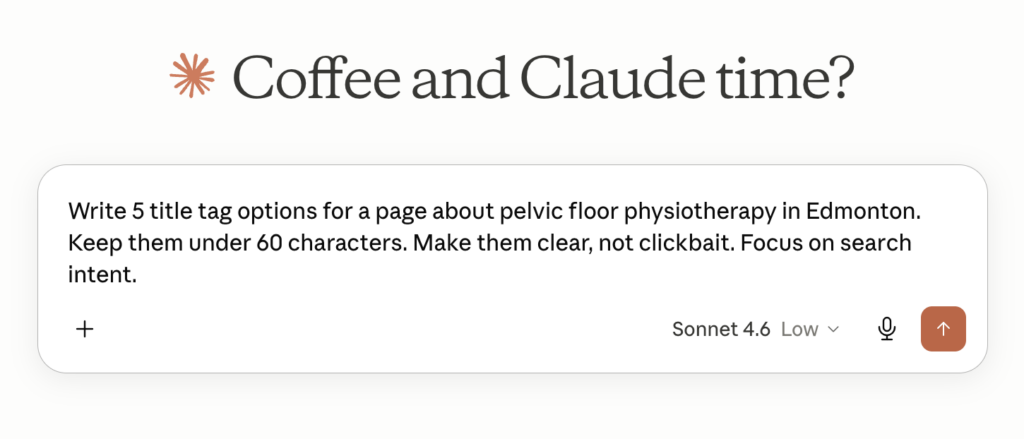
A beginner-friendly example could be:
“Write 5 title tag options for a page about pelvic floor physiotherapy in Edmonton. Keep them under 60 characters. Make them clear, not clickbait. Focus on search intent.”
This kind of structure helps you learn faster because you are learning how to guide AI rather than just use it.
If You’re Building Confidence and Ready to Go Deeper: Shift Toward Repeatability
Once you are comfortable with one-off AI tasks, the next step is building repeatable processes. Instead of asking, “how do I use AI for this one thing?” start asking, “how do I use AI to make this recurring task faster and better every time?” For example:
- Building prompt templates you can reuse for content audits, briefs, or client summaries.
- Using AI features inside tools you already have, like Notion AI, Google Search Console integrations, or CMS plugins.
- Standardizing inputs so you are not starting from scratch each time.
- Saving prompts that consistently produce useful results.
- Creating simple step-by-step workflows for recurring tasks.
This is where AI workflow automation and tool stacking start to fit. You may not be building anything especially advanced yet, but you are starting to connect the dots between tools and steps. For example, you might pull research into a doc, run it through a saved prompt for summarization, then use a second prompt to turn that into a brief. Or you might use AI inside an existing tool to speed up a task that already happens every week.
A practical example here could be:
- Export page data from your CMS or SEO tool.
- Drop it into a repeatable prompt template for content review.
- Have AI flag missing headings, weak intros, unclear calls to action, or opportunities to better match search intent.
- Then use a second saved prompt to turn those findings into a client-friendly summary.
That is the shift from casual use to repeatable use.
Understand What Data You Have
AI can only help if your inputs are usable. Before thinking about prompts or platforms, get clear on three things:
- What data do I need to help solve this problem?
- What data do I actually have access to?
- What format is it in?
That might include crawl data from Screaming Frog, exports from Google Search Console, local listing data, backlink profiles, internal reports, knowledge base documents, or competitor research.
However, once you have more confidence and more options in front of you, it’s easy to chase interesting ideas that do not actually move your most important work forward. Keep coming back to the question:
Does this idea or data directly support my most important work, right now?
This will help you know if you’re spending time on workflows that directly improve your day-to-day.
If You’re More Experienced and Want to Work at Scale: Think About Orchestration
Advanced priorities shift away from one-off prompting and toward building connected systems. At this stage, AI is helping you move data through a workflow, reduce repetitive work, and synthesize patterns across larger datasets.
At this level, your work may start to look like this:
- Using AI to process crawl exports, Google Search Console data, backlink data, or log files at scale.
- Building automations that reduce repetitive reporting and monitoring tasks.
- Connecting tools so the output of one step becomes the input of the next.
- Creating AI-supported workflows for team processes or client deliverables.
- Building retrieval-based systems that use your own documents, audits, or research as the source for answers.
- Adding checks and review steps so outputs stay reliable over time.
A practical example of AI Orchestration might be a recurring reporting workflow:
- A scheduled export pulls Search Console data.
- An automation tool picks up the file.
- AI summarizes major changes, anomalies, or opportunities.
- The summary is sent to Slack, Notion, email, or a dashboard.
- A strategist reviews the output and adds interpretation before it goes to a client.
Think Beyond Output and Toward Infrastructure
As you get more advanced, you start moving from “How do I use AI for this task?” to “How do I make this run reliably every time?” Inputs, tools, review steps, and outputs all need to connect in a way that is repeatable and, hopefully, resilient.
Once AI becomes part of a real workflow, you need some way to check whether it is still producing useful, accurate results. Always make sure a real person is involved in analysis and review. AI shouldn’t be doing your work for you, it should help you be more productive and efficient.
At this stage, the same core principle still applies: the fact that something is advanced does not automatically make it valuable. The real questions are still the same:
- What is the output you are trying to get?
- Who does it serve?
- What recurring problem does it solve?
Step 3: Filtering What Content and Resources Are Worth Your Time
There is too much content about AI and SEO. New things launch weekly. Staying current requires discipline as much as curiosity. Before you invest time in any piece of AI content, run it through the questions that you answered during the first step of this framework:
- Does this apply to my specific niche and client type?
- Is this relevant to where I am in my learning right now?
- Is this person sharing real experiments with real outcomes, or just commentary?
- Is this a tool or workflow I could use in my day-to-day work?
This filter mindset is a skill itself. Learning to evaluate whether a resource is worth your time is just as valuable as the content itself.
Step 4: Maintaining Your Momentum Through Community, Accountability, and Staying Current
This is the section that usually gets treated as an afterthought. Knowing what to learn means nothing if there’s no realistic structure for learning it sustainably over time.
Finding Your Community and Support System
SEO has always been a community-driven industry. AI learning in SEO is no different. Finding even a small, trusted group of peers who are navigating this shift alongside you, whether that’s a Slack community, a local meetup, or even just two or three work peers changes the experience.
The key is finding a community that matches your level, your niche, and your pace. Not every community will be right for you.
A community that moves fast and posts constantly about advanced automations can feel demoralizing if you’re just getting started. Even though those people aren’t doing anything wrong, they’re just further along on a different path.
One community worth mentioning for SEOs is Women in Tech SEO, which covers a broad range of SEO topics and has different channels for different specializations. It’s a welcoming place to meet people and ask questions without judgment, and maybe find some other SEOs who want to join in a learning journey of accountability.
If you’ve been in a few communities and haven’t found the right fit yet, don’t give up! Consider being the one to start something more specific in your area or niche. Some of the most useful learning groups are small, informal, and built around people who are solving similar problems.
Making Time and Building Accountability
The SEO industry does not slow down. There will never be a naturally quiet period when learning feels effortless. Which means if time for learning isn’t protected, it won’t happen.
Think through three different types of learning time:
- Catch-up time: A regular block (maybe 15–20 minutes, maybe Monday morning) where you scan for what’s changed in the industry. This is skimming, not deep learning. Trusted newsletters, specific feeds you’ve curated, nothing overwhelming.
- Deep dive time: Protected time (could be daily, could be once or twice a week) where you go deeper on something specific. This is reading, practicing, building.
- Experiment time: Time you try something in the context of real work. This doesn’t need to be separate from client work, it often can’t be. But the intention matters.
For accountability: if you know you won’t follow through on something alone, don’t try to do it alone.
Build in a check-in with a colleague, join a course with a community component, or set up something like a habit tracker or a 15-minute recurring Zoom with someone who’s also trying to build this skill with you (or at least a similar skill). The structure that works for you is the structure you’ll actually use.
Remember, You Don't Need to Know It All.
The people who do it well are the ones who know what matters for their work, their clients, and where they’re going.
If you’ve made it through this framework and answered the questions honestly, you now have something most “AI for SEO” content doesn’t give you: a real starting point that’s yours.
You know who you serve. You know what your day-to-day life looks like. You know where AI can help you first. You know your learning style and your honest bandwidth. And you know it’s okay, more than okay, to start small and go at your own pace.
Start with one thing. Do it for the work that matters most to you right now. Then build from there.
Ready to take the next step?
- Explore learningaisearch.com and use the self-audit above to find your starting point.
- Looking for community? Explore Women in Tech SEO, Orange Labs, or search for SEO-focused groups and local meetups in your area.
- Sign up for our Kick Point newsletter for regular, practical SEO and AI insights.
