Key Points
Reduce, don’t pause. A smaller budget keeps campaigns active and the algorithm learning, while pausing means starting from scratch when you need performance most.
Check your competition. Whether your competitors are pulling back or staying in, maintaining a presence protects your share of the auction either way.
Timing matters. The businesses that handle slow seasons best are the ones that planned for it, not the ones reacting to it mid-flight.
Slow season hits, the pipeline quiets down, and suddenly that Google Ads budget starts to feel like an easy place to cut. If nobody’s buying, why keep paying for clicks?
It’s a reasonable instinct. And for some businesses, pulling back makes complete sense. But the decision is rarely as straightforward as it seems, and making it at the wrong time (or for the wrong reasons) can cost you more than the budget you were trying to save.
We’ve had this conversation with a lot of clients. Here’s how we think about it.
First: are you planning ahead or caught mid-season?
There’s a big difference between building your slow season into your annual budget plan and deciding to pause in a panic when July looks quiet.
If you’re in budget planning mode, you’re in good shape! You have time to make a thoughtful call, set realistic budgets for slower months, and adjust strategy without disrupting campaign performance.
If you’re mid-season and suddenly wondering whether to turn things off, that’s a harder spot. Not impossible to navigate, but the cost of reacting in the moment can be higher than you might expect.
Either way, the thinking below applies. But the earlier you make this decision, the better.
What actually happens when you pause
Google Ads isn’t a light switch. When you pause campaigns and then turn them back on, there’s a ramp-up period before performance returns to where it was.
This is because Google’s bidding algorithms are constantly learning—what times of day your audience converts, which keywords perform, what bids make sense for your goals. That learning is built on data. When you pause a campaign, that data stops accumulating. When you turn it back on, the system has to relearn, often with worse initial performance and higher CPCs while it does.
For seasonal businesses running campaigns year after year, this ramp-up cost is real and worth factoring into the decision.
The case for reducing instead of pausing
Our default recommendation: don’t pause. Reduce.
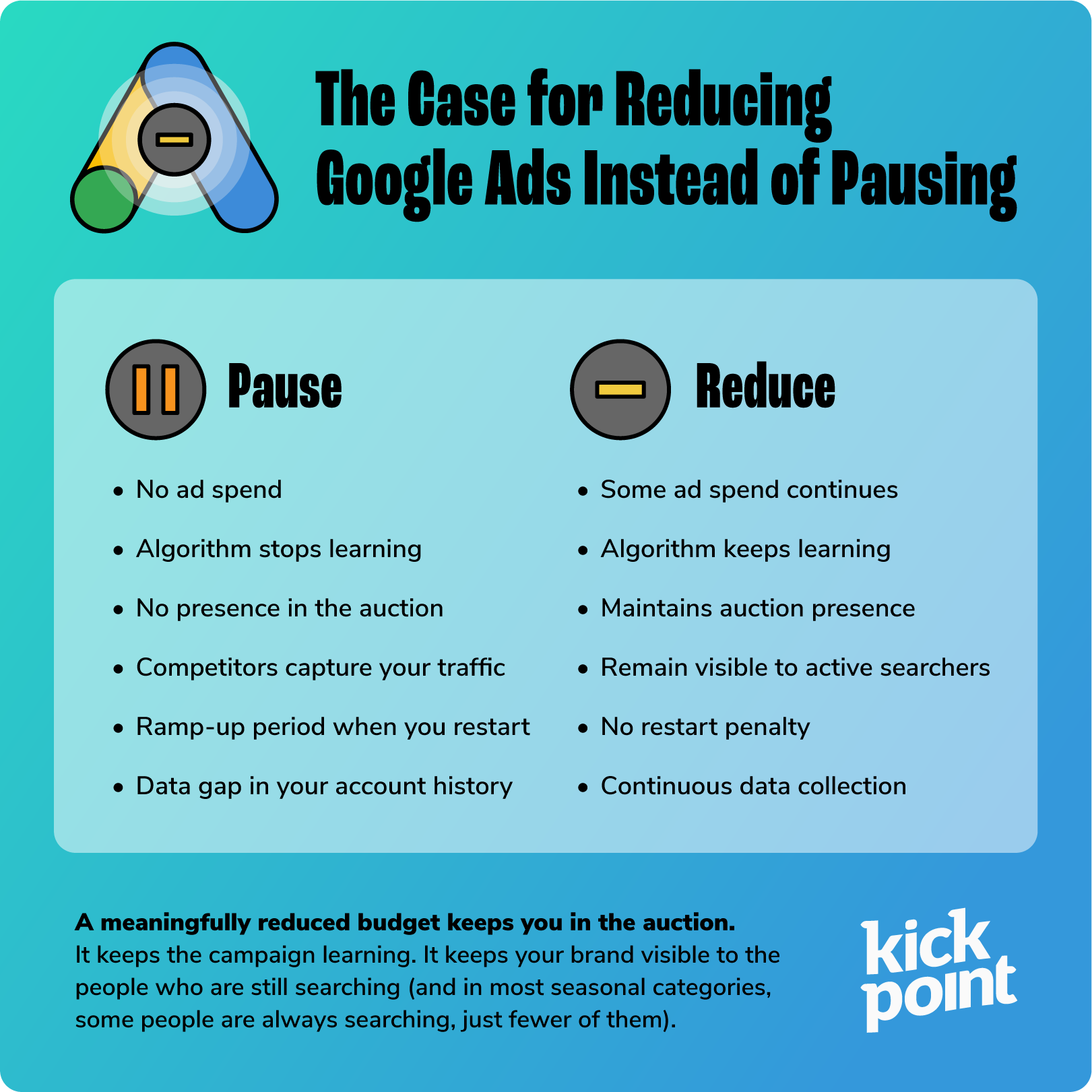
A meaningfully reduced budget keeps you in the auction. It keeps the campaign learning. It keeps your brand visible to the people who are still searching (and in most seasonal categories, some people are always searching, just fewer of them).
There’s a big difference between spending less and spending nothing. A reduced budget keeps you in the auction and feeds the algorithm. Pausing the campaign means starting over when you’re ready to turn things back on, and that restart can cost you.
Keep in mind, drastic budget changes from one month to the next can destabilize campaign performance. Google’s algorithm doesn’t respond well to sudden shifts, a gradual ramp down into slow season (and back up coming out of it) is much less disruptive than flipping between high spend and nothing. If you’re building a seasonal budget at the start of the year, map this out intentionally rather than making sharp cuts in the moment.
Tip: A good rule of thumb is to aim for no more than a 20% increase/decrease month to month when possible.
"Won't the algorithm learn the wrong things during the slow season?"
This is a fair question!
Yes, slower seasons mean less conversion data: fewer clicks, fewer form fills, fewer calls. And yes, Google’s algorithm performs better with more data. But the algorithm doesn’t learn in a vacuum. It’s learning about your market, and your market is genuinely slower sometimes. A lower conversion volume in January isn’t bad data, it’s accurate data.
The bigger risk is pulling out entirely. A paused campaign gives the algorithm nothing to work with. When you come back in peak season, it’s starting from scratch in a now-competitive auction. Reduced spending during slow months gives it enough signal to maintain what it’s learned, even if it’s not adding much new information.
Where this does require attention is your bidding strategy targets. If you’re running a Target CPA or Target ROAS strategy, make sure your goals are calibrated to slow-season expectations. Asking the algorithm to hit peak-season CPA targets with slow-season volume is where things can go wrong. If you’re using a Max strategy, like Maximize Conversions, the slow season is a good time to consider adding a target CPA to create some guardrails. Otherwise the algorithm will spend whatever it takes to find conversion, which can get expensive when volume is low.
Don't hand your customers over to your competitors
If you’re wondering if you should pause your ads during the slow season, your competitors are likely asking the same question.
In some industries, it’s common to see lots of companies pulling back. When (and if) that happens, there’s less competition in the auction, which usually means a lower cost per click and more visibility for the same spend. The buyer who’s dreaming about a boat in February and buying in May is a real person, and if you’re the only one talking to them, that’s a meaningful edge! If your business has a longer sales cycle, a lot of research could be happening during your slow season. If you’re not there for it, someone else is. And if your slow season looks dead in your account, it’s worth looking beyond end-of-funnel conversions. Higher-funnel conversions like product page views and return visits can tell a different story.
But don’t assume your competitors are pulling back. Check your auction insights data. It’ll show you who is in the auction with you and how their impression share is trending. If competitors are reducing, staying in is an opportunity. If they’re not, pausing means handing them the whole auction while you wait for things to pick up.
What to do instead of pausing
I think slow seasons get a bad rap. With the right approach, it can actually be one of the more productive times to be running ads.
- Reduce, don’t eliminate. Pull back to a level that keeps campaigns active and learning without overspending. What that number looks like will depend on your industry and goals, but a modest presence is better than none.
- Shift your focus. Not everything slows down at the same time. If there are other parts of your business that stay active through your off-season, a slow season is a good opportunity to put some ad dollars there instead.
- Use the quiet period to test. Peak season isn’t always the best time to experiment, as there can be too much risk if it goes wrong. Your slow season is a good window to test new ad copy, landing page variations, or campaign structures without the pressure of your highest-value months.
- Revisit your bidding targets. If you’re running Target CPA or ROAS, your goals should reflect what slow season actually looks like for your business, not what your busiest months look like. The algorithm will make poor decisions if you’re asking it to hit peak-season targets with a fraction of the usual volume.
Tip: Make sure your agency knows this information before your slow season hits. It’ll make things easier.
Running Performance Max? PMax campaigns run entirely on signals and therefore are even more sensitive to pausing and sudden budget changes than search campaigns. If there’s one campaign type where pausing has a real cost, it’s this one: keep it running and reduce budget gradually if you need to pull back.
When pausing does make sense
There are some situations where pausing is the right call.
- Your budget is very small. If your total annual budget is limited, spreading it thinly across 12 months can mean you’re never spending enough to be competitive at any point. In that case, concentrating on your peak months might be the smarter call than running ineffectively year-round.
- There’s genuinely no demand. In some categories, search volume in the off-season drops to near zero. If nobody’s searching, there’s nothing to capture, and a minimal budget won’t change anything. Check Google Trends and your own historical impression data before assuming this is you, but if it is, pausing is reasonable.
- The business is closed or the budget needs urgent reallocation. If you’re physically shut down or facing a situation where ad spend genuinely needs to go somewhere else, pause with a plan. Know when you’re coming back, and build the ramp-up time into your expectations.
What about pausing certain ad groups, instead of the campaign?
Pausing entire campaigns isn’t the only lever you have. If you have seasonal products or services within a campaign, pausing individual ad groups during their off-season is a reasonable way to keep budget focused on what’s actually relevant right now.
The catch is reactivation. Paused ad groups go through a similar warm-up period as paused campaigns. If you know a product peaks in May, turning that ad group back on in May is too late. We typically aim to reactivate seasonal ad groups 2-4 weeks before peak season, though lower volume accounts may need more runway. The less conversion data your account generates, the longer the algorithm needs to find its footing.
This is largely budget-dependent. If budget isn’t a constraint, there’s an argument for leaving those ad groups running year-round. You keep the algorithm learning, you capture any off-season searchers, and you avoid the warm-up period altogether when peak season arrives. If your campaigns are limited by budget and off-season conversion rates drop significantly, pausing those ad groups redirects even modest spend toward what’s actually performing. The goal is to concentrate your budget where it’s most likely to perform, not spread it thin across the whole account.
So, should you pause?
If your slow season is predictable (and for most businesses, it is) the best time to make this decision is before it arrives. Build your budget seasonally at the start of the year, plan for reduced spend in slower months, and decide in advance whether you’re reducing or pausing and why.
Every business’s slow season looks a little different, and the right call depends on your budget, your industry, and what your competitors are doing. If you want to talk through what makes sense for your account, we’d love to help.